Ankra is now ankra.ai: Rewritten in Go, Ready for What's Next
On this page
The product has been pointing at this for a year: an AI that runs your operations, not one that just answers questions about them. This month the name caught up. Ankra is now ankra.ai. Same platform, same clusters, new center of gravity.
Underneath the new name sits the biggest engineering release we have ever shipped. Here is everything that landed since March: the Go rewrite, an AI that owns the incident loop, a complete identity stack, European managed multi-cloud, and Ankra on your phone.
Ankra goes all the way with Go

Over the past two quarters we re-engineered the Ankra Agent and the Ankra backend in Go: the API, the work schedulers, the maintenance loops, the GitOps reconciler, and the chat pipeline. Performance is now a first-class focus, and the gains are platform-wide. Go has taken our headroom to 25x the scale on the same footprint, and the speed-up is felt everywhere, from API responses to reconciles to chat. As Ankra picks up traction, this is the foundation we are building toward enterprise-grade scale.
What that means in practice:
- A fraction of the footprint. The agent now runs with a 512Mi memory limit, down from 1536Mi. Same reconcile work, a third of the reservation, on every cluster you run.
- Built to scale 25x. No runtime to warm up, no interpreter in the path. Go lets the platform absorb an order of magnitude more load, so performance holds as you grow into enterprise-grade fleets.
- Zero action required. The Go agent on the
2.0.xtrack is a drop-in replacement, rolled out across the fleet automatically. Your stacks, operations, and workflows carry over untouched. - One binary everywhere. A single statically compiled binary per platform. No dependency tree, no runtime patching, a smaller surface to attack and to audit.
Describe the problem. Approve the fix.
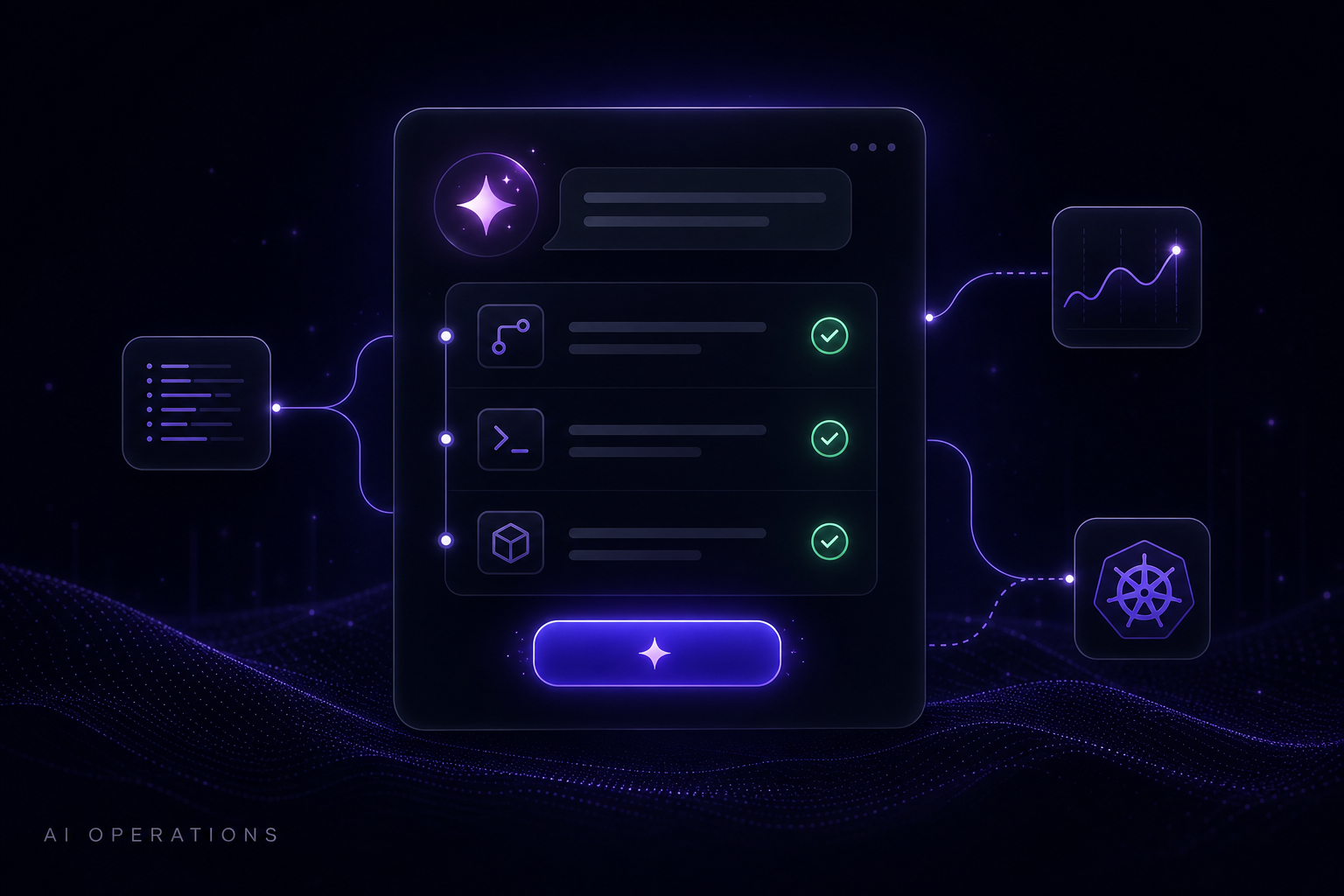
Most of every incident is spent collecting evidence. The AI assistant now owns that loop: tell it the symptom and it correlates logs, events, manifests, metrics, Stack history, and Git state, drafts a multi-step plan, and executes it with your approval at every mutating step. It remembers context across conversations, reaches your own tools over MCP, and nothing changes without you. Between incidents, AI Insights keeps scanning, adapting to what your clusters actually run.
Prefer your own agent? Point Cursor, Claude Code, or anything with a terminal at the Ankra CLI and it becomes a cluster-aware infrastructure subagent: real cluster state, incident triage with ankra chat, and every change landing as a reviewable draft, never a raw kubectl edit. We wrote a full guide on wiring Cursor up as an Ankra subagent.
Security that keeps up with you
This quarter shipped a complete identity stack. Native two-factor authentication and multi-social sign-in, built into every surface you use: browser, CLI, and now mobile.
- Passkeys, natively. Sign in with Touch ID, Face ID, or Windows Hello, the credential your device already trusts, with hardware security keys and authenticator-app codes (TOTP) alongside, and one unified set of recovery codes.
- Step-up at every sign-in. Verification happens on each login, and
ankra logincompletes MFA in the browser before dropping you back in the terminal. - Enforce it for the whole organisation. Require MFA org-wide, with admin reset for locked-out teammates.
- Sign in your way. Google, Apple, GitHub, or email and password. Link them to one account from Profile → Authentication.
- Beyond login. Trivy Operator vulnerability reports on a dedicated cluster Security page, kubeconfigs that expire on their own,
--strict-secretsvalidation in CI, and checksum-verified CLI upgrades.
The platform, in your pocket
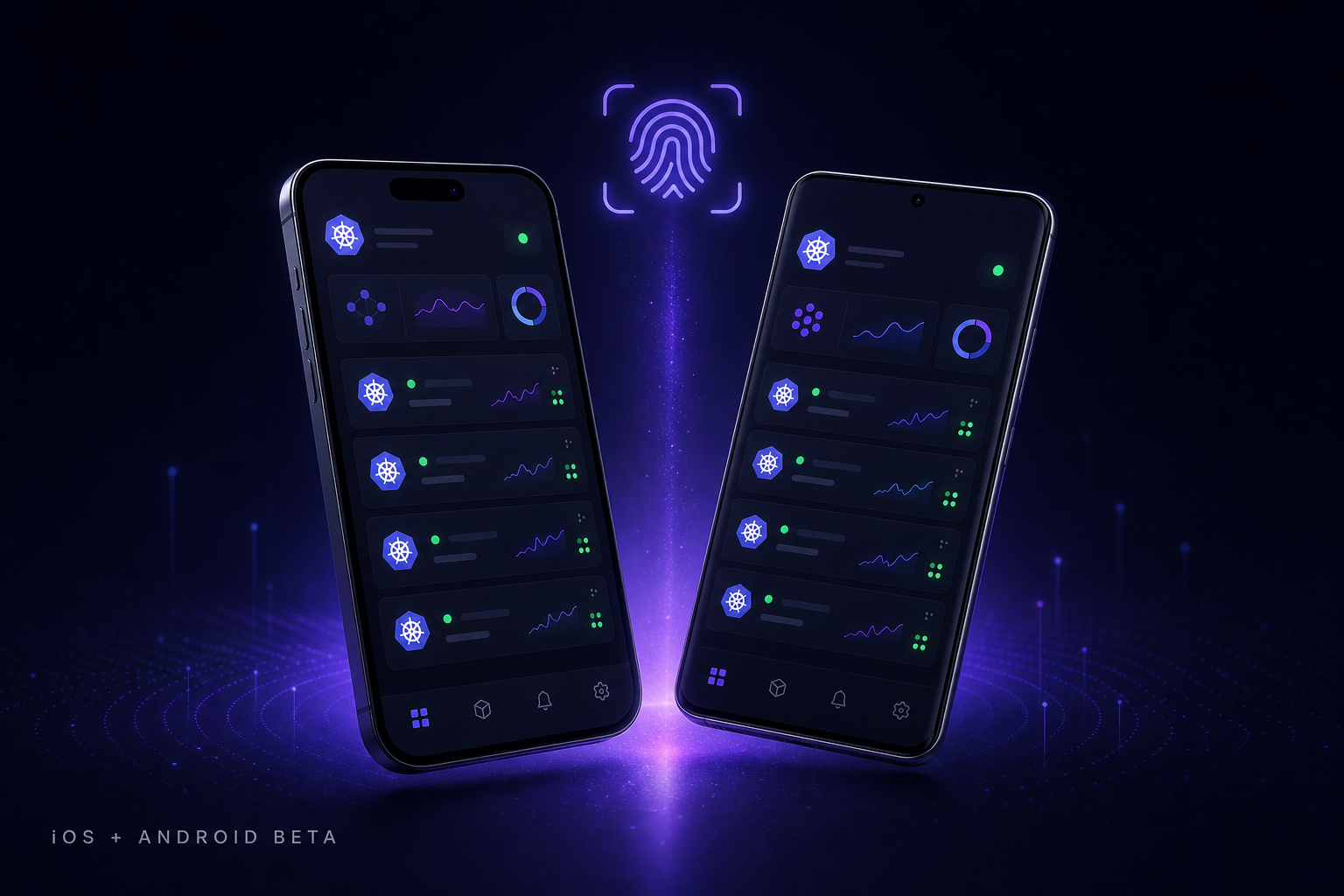
Ankra is now on iOS and Android in beta. Mission Control, cluster health, live operations, AI chat, and AI Insights, from wherever the page finds you. And the security stack above is built in from the first unlock: Face ID or Touch ID on iOS, BiometricPrompt on Android, automatic re-lock the moment the app leaves the foreground, device passcode as the fallback.
The beta ships through TestFlight and Google Play internal testing. Reach out on Slack and we will send you an invite.
European by default. Sovereign by design.
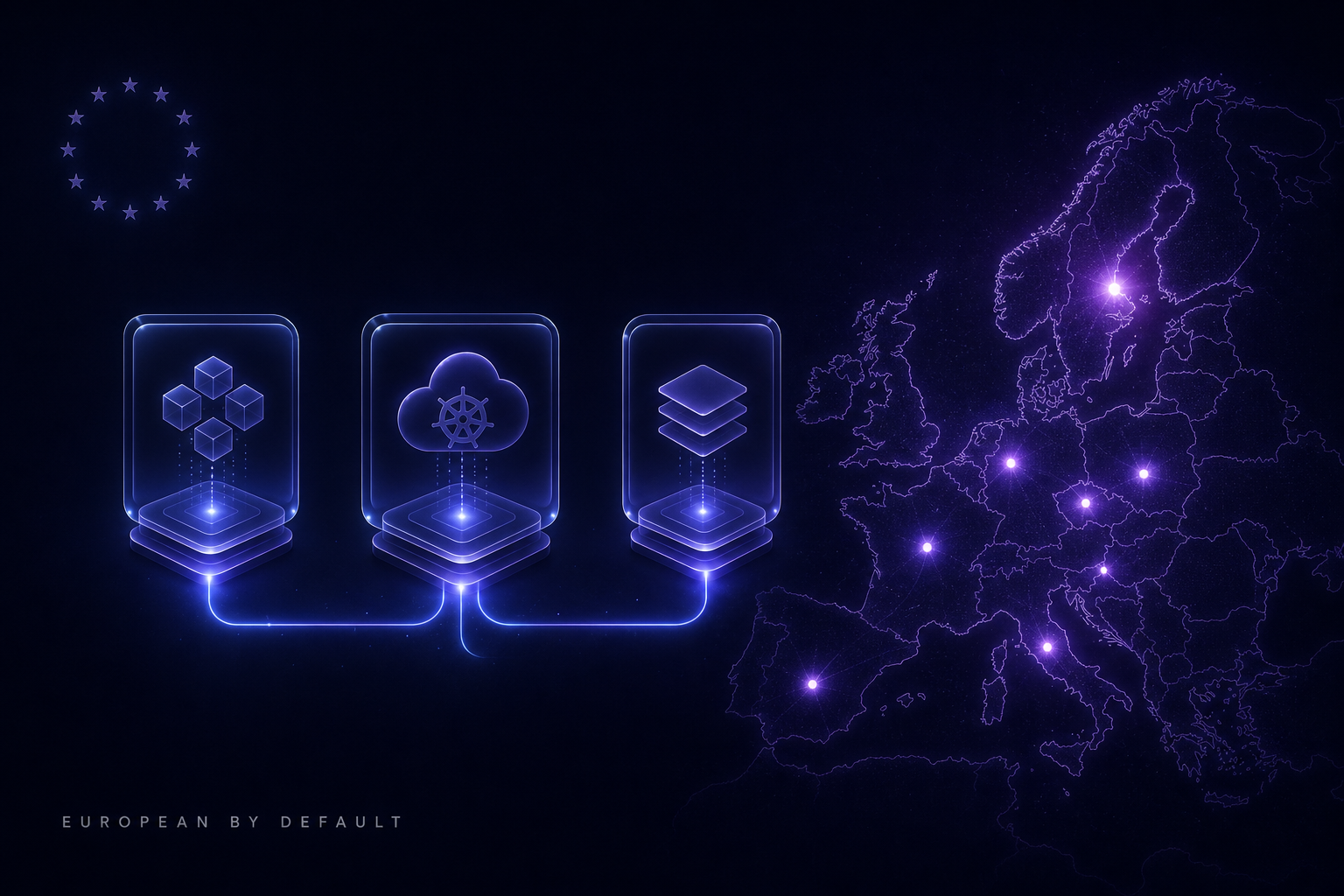
Ankra was founded in Sweden and built for Europe, and our managed clusters reflect it. Provision and run production Kubernetes on Hetzner, OVH, and UpCloud, three European clouds, from one console and one set of commands. Your control plane, your data, and your workloads stay on the continent, under EU jurisdiction. No hyperscaler lock-in, no data leaving the region unless you choose it.
- Three European clouds, one workflow. Create, scale, upgrade, and deprovision with the same provider-agnostic commands, wherever the cluster runs.
- Data residency you control. Keep clusters and data inside the EU, close to your users and inside your regulatory perimeter, without giving up the managed experience of a hyperscaler.
- Roots in Sweden and the EU. We are a European company by conviction, not convenience. Digital sovereignty is not a feature we bolted on; it is the reason Ankra exists.
- No lock-in, ever. Standard Kubernetes, GitOps as the source of truth, and clusters you can move between providers. Your platform is yours to take anywhere.
Deploying your app
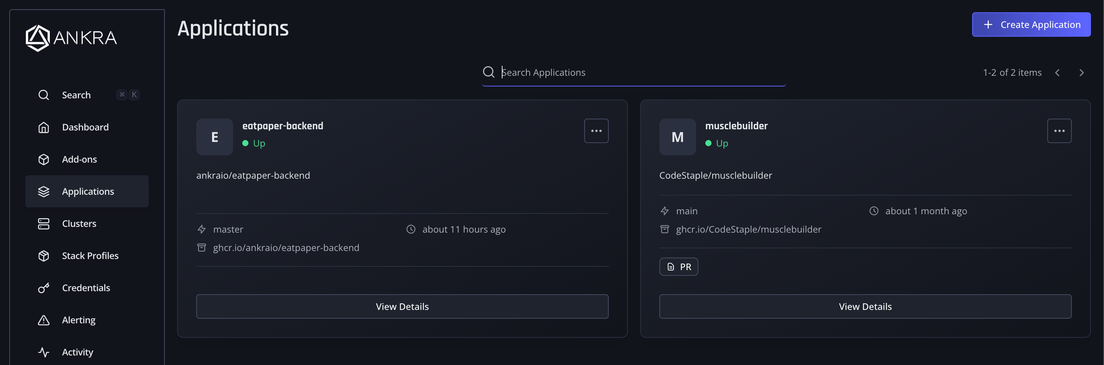
Connect a repo, get a running app. Applications takes a repository and generates the Dockerfile, Helm chart, and CI pipeline as a pull request, then deploys the result to your cluster as a stack. Review the PR. That is the whole handoff. It is in closed beta today: open Applications in the platform to join the waitlist.
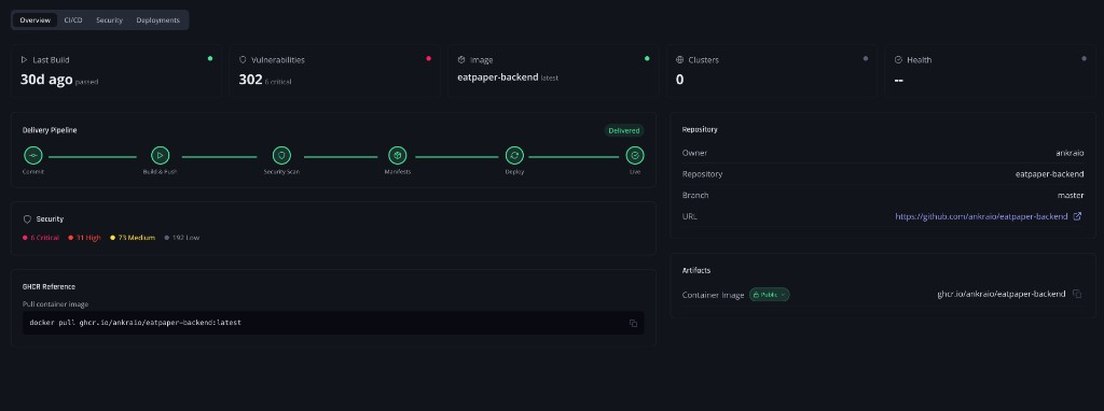
Commit to live in one view: the delivery pipeline, image vulnerabilities, and the GHCR artifact, all tracked per application.
Capture a working stack once, apply it anywhere. Stack Profiles turn a proven stack into a versioned template for any cluster: ankra stack-profiles get and apply from the CLI, with --category to browse by what they do.
Take the safe path to production. ankra cluster draft stages the change, validate --strict-secrets fails CI before a plaintext secret lands in Git, then deploy with --watch and follow it land from the terminal. Changing one value? Helm-style --set patches it atomically, with --dry-run to preview first.
Maintaining your app
Retire the ArgoCD runbook. Ankra’s own engine now reconciles your clusters natively: nothing to install, upgrade, or unstick, and the same Git-as-source-of-truth workflow. Existing clusters migrate addon-by-addon.
One set of verbs for every cloud. ankra cluster upgrade, scale, node-group: the same commands wherever the cluster lives. The provider is a detail, not a prefix you have to remember.
Upgrades that don’t gamble with your workloads. ankra cluster upgrade now covers kubeadm clusters alongside k3s: one node at a time, control plane first, each node cordoned and drained respecting PodDisruptionBudgets, with an etcd snapshot taken before the control plane moves. A blocked drain aborts safely; --force only when you say so.
Stop paying for idle clusters. Delete a cloud cluster’s infrastructure to stop the charges while it stays registered in Ankra, then restore it on demand, even reshaped: controllers, instance types, node groups.
Clone environments, not runbooks. Select every stack and clone to another cluster, even across organisations, in one operation, name conflicts resolved automatically and variables resolving per scope so the clone fits its new home.
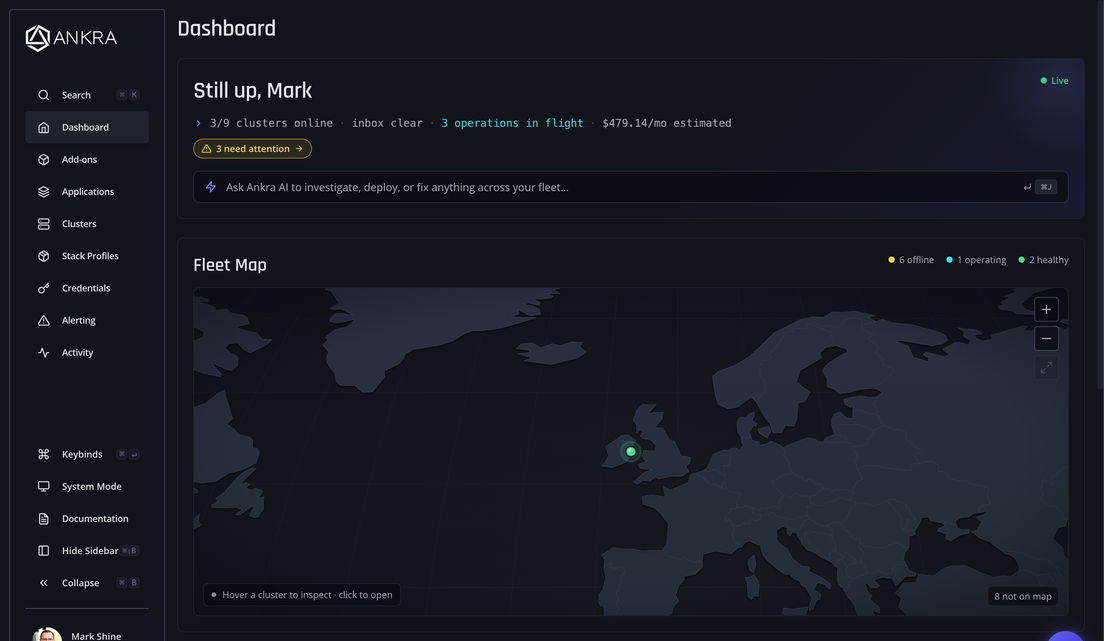
See the whole fleet at a glance. Operations live-update as they run, PromQL queries work straight from the CLI, and the dashboard puts your fleet on a world map with cloud cost beside it.
Also shipped
- On Bitbucket? You’re in. Bitbucket Cloud joins GitHub as a GitOps provider, and GitHub users can switch to App installs, with scoped, revocable access instead of long-lived personal tokens.
- kubeadm, end to end.
ankra cluster kubeadm-versionslists upgrade targets, and cloud creates take--etcd-topologystacked or external with 3- or 5-node dedicated etcd. - Two-factor from the terminal.
ankra profile authenrolls, lists, and removes MFA methods without opening a browser tab. - The CLI updates itself.
ankra upgradetakes you to v0.5.0 with a verified checksum and swaps the binary in place; pin a version to roll back. - One terminal, many targets. Global
--organd--clusterflags apply per request, and kubeconfigs now pin the owning organisation, so kubectl keeps working after you switch orgs. - Stack edits without opening the UI. Edit dependency ordering, print addon values or manifest YAML, delete manifests, and keep node SSH keys in sync (
ankra ssh-keys get/set/resync) from the CLI. - Guardrails for scripts and humans alike. A documented exit-code contract so pipelines branch on the failure class, and every destructive command confirms before acting.
- Claude Code joins Cursor.
ankra skills --editor claude-codeinstalls the curated Ankra practices into your coding agent of choice. - The CLI reference writes itself. Generated from the command tree and synced to the docs on every release, so the reference never drifts from the binary you run.
- Removed: add-on subscriptions. Add-ons are now managed directly on the cluster or stack; legacy subscription endpoints return
410 Gone.
Why the name changed
A year ago, Ankra was where you managed Kubernetes. Today it is where you deploy an app, keep it healthy, and hand the 3am incident to an agent that fixes it with your approval, from a terminal, a browser, or the phone on your nightstand. ankra.ai is not a rebrand. It is a description.
Faster than you remember it. Same clusters, new engine. Open Ankra or read the full changelog.
Get the next post in your inbox
Related Posts
AI Tools for Kubernetes Operations in 2026: Troubleshooting Assistants, Agents and MCP Servers
Twelve AI tools for Kubernetes compared, from open source troubleshooters to AI operations platforms and MCP servers, and how each one handles write access.
We Moved Our Production to UpCloud. Here Is What Sovereignty Actually Cost.
Ankra's own platform now runs in Helsinki. The timeline, the bill, the benchmark numbers, and the places UpCloud let us down, from the team that did the move.